
Inputs → figure
Rock Layers Diagram Generator
Create an AI rock layers cross-section from a supplied bed sequence. Review upright undisturbed strata and relative-age labels, then download the original PNG.
Checking AI availability…
Example input
Start with a reproducible example
Self-authored, simulated teaching input for exploring this workflow. It is not a user’s research or a public gallery submission.
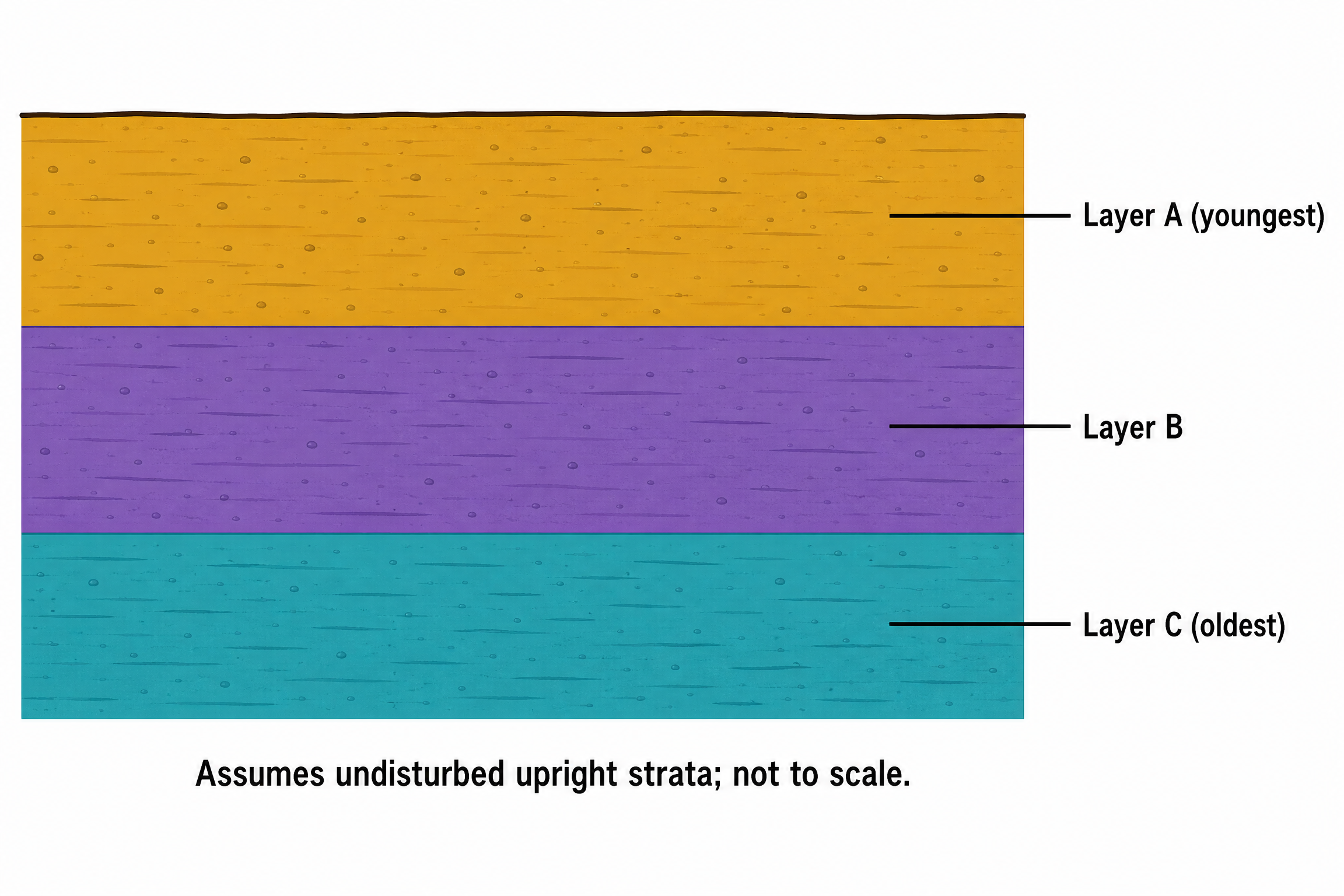
Create a full-color conceptual teaching cross-section of exactly three horizontal, undisturbed, upright sedimentary beds on white. Use a distinct gold top bed, violet middle bed and teal bottom bed. Put exactly three labels to the right with non-crossing horizontal leader lines: Layer A (youngest) points inside the top bed, Layer B points inside the middle bed, Layer C (oldest) points inside the bottom bed. Show all three beds continuously from left to right beneath one thin ground-surface line. The colors distinguish beds only and must not imply named rock types. Do not add an extra soil layer, faults, folds, fossils, intrusions, numeric ages, depth scales or measured results. Add the exact footer: Assumes undisturbed upright strata; not to scale.
Reviewed output · self-authored simulated inputRead the example input
{
  "style": "flat-color",
  "brief": "Create a full-color conceptual teaching cross-section of exactly three horizontal, undisturbed, upright sedimentary beds on white. Use a distinct gold top bed, violet middle bed and teal bottom bed. Put exactly three labels to the right with non-crossing horizontal leader lines: Layer A (youngest) points inside the top bed, Layer B points inside the middle bed, Layer C (oldest) points inside the bottom bed. Show all three beds continuously from left to right beneath one thin ground-surface line. The colors distinguish beds only and must not imply named rock types. Do not add an extra soil layer, faults, folds, fossils, intrusions, numeric ages, depth scales or measured results. Add the exact footer: Assumes undisturbed upright strata; not to scale."
}
Load the disclosed simulated illustration brief and review every label, connection and scientific detail. AI results vary between runs.
State the assumptions behind relative layer order
The default cross-section contains exactly three continuous horizontal sedimentary beds beneath one ground-surface line. Layer A (youngest) is at the top, Layer B in the middle and Layer C (oldest) at the bottom. This relative ordering assumes an undisturbed, upright sequence; color distinguishes the beds without identifying a rock type.
Image 2 at 2K turns the confirmed brief into an independent raster draft. Check bed continuity, the three label endpoints and the absence of extra layers. The illustration does not measure depth, determine numeric ages or reconstruct a surveyed outcrop. Faults, folds and intrusions require different supplied relationships, and the example is not a rock-cycle diagram.
Verify exactly three continuous beds
Trace each gold, violet and teal bed from left to right. The thin ground-surface line must not become a fourth soil layer. Reject interruptions, tilted beds or unrequested structural features.
Check relative ages against the stated assumptions
Layer A (youngest) must identify the top bed, Layer B the middle and Layer C (oldest) the bottom. Keep the undisturbed-upright assumption visible; this teaching convention is insufficient for interpreting a real disturbed exposure.
Do not infer geology from decorative choices
Colors and drawn bed thicknesses are design choices. Without supplied geological observations they establish neither rock type, numeric age nor measured depth. Preserve the not-to-scale footer and exclude unrequested fossils, scales and intrusions.
Review reference: NPS: fundamental geologic principles. Check every label, direction and structural assumption against an appropriate subject reference.
How to use this tool
- Describe the subject and the exact relationships to show.
- Choose a style and aspect ratio; optionally add one permitted PNG reference.
- Review the brief and explicitly confirm generation.
- Inspect the result against the supplied scientific details.
- Download the original PNG or revise the brief for a new image.
Specifications and limits
- Route
- Independent Image 2 2K raster illustration; separate from native diagram engines
- Controls
- Scientific brief; line art, flat color or semi-realistic style; supported aspect ratios; optional PNG reference
- Reference
- One PNG up to 5 MiB, 8192 pixels per side and 24 million pixels; only material you may send
- Output
- Original PNG; labels are pixels, without SVG, PPTX or independently editable annotations
- Review
- User scientific review required; no scientific-accuracy or publication-acceptance guarantee
- Scope
- Undisturbed upright sedimentary beds; no measured geology or rock-cycle model
Guest native edits stay in this tab until you explicitly save a confirmed figure. Sign in to keep private works and revision history. Saved native works restore the figure and exports, not the original input form. AI tasks, images and references are private to their owner. Subscriptions and one-time packs are available for AI allowances. Native drawing and exports remain free. Understand export formats.
Frequently asked questions
Why is the youngest layer at the top?
The default teaching section assumes undisturbed, upright sedimentary strata. Under those stated assumptions, it labels the top bed Layer A (youngest) and the bottom bed Layer C (oldest). Do not transfer this reading to overturned or disturbed structures without further interpretation.
Do gold, violet and teal identify particular rock types?
No. The example uses gold for the top bed, violet for the middle bed and teal for the bottom bed only to distinguish them visually. It does not assign lithology or infer composition from color.
Can this determine the ages or thicknesses of real strata?
No. The example excludes numeric ages and depth scales and is not to scale. It does not date rocks, calculate thickness or replace field observations and geological interpretation.
Can I request faults, folds or intrusions?
A different supplied brief can describe them, but those structures fall outside the default undisturbed section. Specify their relationships and review them independently; a simple youngest-at-top rule may not resolve a disturbed or overturned sequence.
Is this a rock-cycle diagram generator?
The default tool page focuses on a stratigraphic cross-section, not transformation among igneous, sedimentary and metamorphic rocks. It requests three beds and no rock-cycle process arrows.
Can I revise a reference section or edit labels later?
You may attach one eligible PNG you have permission to send and describe a revision. Inspect the new draft for changed layer order and label endpoints. Downloaded labels are pixels in the original PNG, without independently editable SVG or PPTX objects.