
Inputs → figure
Sentence Diagram Generator
Type an English sentence to create a Reed-Kellogg diagram for supported structures. Review ambiguous parses and see when a sentence is outside the tool's scope.
Last valid diagram shown. Review your edits and create the diagram before exporting.
Native rendering runs in this tab · AI submissions are stored separately
SVG and PPTX retain native text and shapes. PDF currently supports basic Latin text. Check font substitution in your editor.
Example input
Start with a reproducible example
Self-authored, simulated teaching input for exploring this workflow. It is not a user’s research or a public gallery submission.
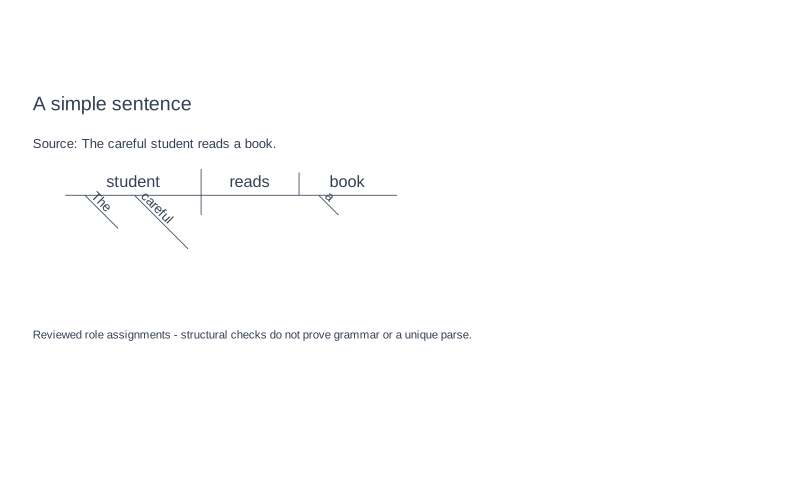
Use the exact self-authored sentence: The careful student reads a book. Assign 3=subject, 4=verb, 6=object; The/careful modify student and a modifies book. Confirm role review before Create.
Reviewed output · self-authored simulated input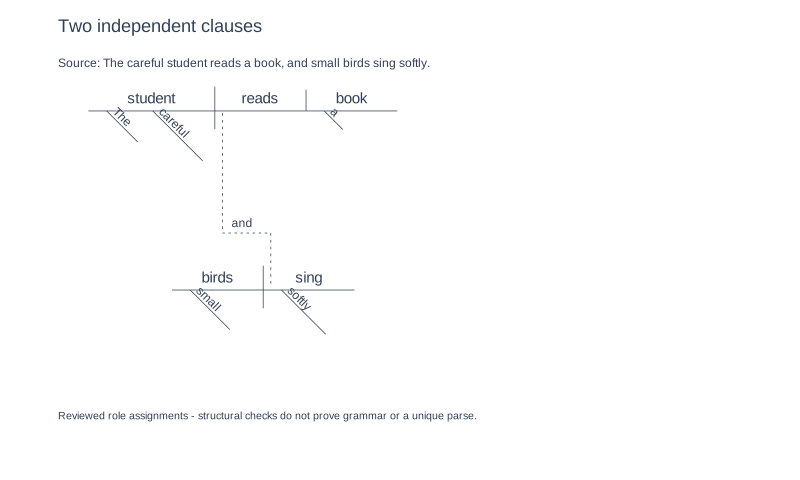
Use: The careful student reads a book, and small birds sing softly. Preserve all eleven words, and as conjunction, source indices and reviewed modifier heads.
Reviewed output · self-authored simulated inputRead the example input
{
  "title": "A simple sentence",
  "sentence": "The careful student reads a book.",
  "conjunction": null,
  "clauses": [
    {
      "subject": 3,
      "verb": 4,
      "object": 6,
      "modifiers": [
        {
          "token": 1,
          "head": 3,
          "kind": "article"
        },
        {
          "token": 2,
          "head": 3,
          "kind": "adjective"
        },
        {
          "token": 5,
          "head": 6,
          "kind": "article"
        }
      ]
    }
  ]
}
Use Load example to recreate the native figure and inspect its text, shapes and source values.
How a sentence is mapped to a diagram
This local Reed–Kellogg implementation draws from explicitly reviewed word roles, not a guaranteed automatic parse. Each supported clause has a single-word subject, a single-word active verb, an optional single-word direct object, and directly attached article, adjective or adverb modifiers. Up to two ordered independent clauses can be joined by an explicit and, but or or. Every source word must be assigned exactly once.
The input is limited to 25 alphabetic English words, each at most 30 letters, with an optional final period and an optional comma before the coordinating conjunction. Questions, contractions, auxiliaries, passive voice, linking complements, prepositional phrases, subordination and compound main roles are outside this scope. AI can propose uncertain roles for review; structural validation does not prove grammatical correctness or a unique interpretation.
Which system we use
This implementation uses a restricted Reed–Kellogg line layout. A subject/verb divider, optional direct-object divider and slanted modifier lines are drawn from reviewed token roles. Syntactic trees are not included.
What we can and can’t parse
Supported clauses are active S-V or S-V-O with single-word main roles and direct article/adjective/adverb modifiers. Two independent clauses may use and, but or or. Every source word must appear exactly once. Even within 25 words, grammar or ambiguity may fall outside this conservative scope.
Reading the diagram
Review each word, modifier head and clause boundary, then confirm the review checkbox before Create. AI suggestions remain proposals; structural coverage checks do not certify the grammar. Changing the sentence clears role assignments and requires a new review.
How to use this tool
- Enter the source English sentence without changing its words.
- Assign each numbered word a subject, verb, direct-object, modifier or conjunction role.
- Review modifier heads, clause boundaries and every unassigned or uncertain word.
- Confirm the role-review checkbox and create the Reed–Kellogg diagram.
- Inspect the native SVG, PNG, PPTX or basic-Latin vector PDF before using it.
Specifications and limits
- System
- Restricted Reed–Kellogg line layout from reviewed role assignments
- Language
- Alphabetic English words; up to 25 words and 30 letters per word
- Scope
- Active S-V/S-V-O with direct modifiers; up to two independent clauses coordinated by and/but/or
- Other systems
- No syntactic trees, unrestricted English parser or guarantee of a unique parse
- Formats
- Native SVG/PNG/PPTX and basic-Latin vector PDF connected
Guest native edits stay in this tab until you explicitly save a confirmed figure. Sign in to keep private works and revision history. Saved native works restore the figure and exports, not the original input form. AI tasks, images and references are private to their owner. Subscriptions and one-time packs are available for AI allowances. Native drawing and exports remain free. Understand export formats.
Frequently asked questions
What diagramming system does it use?
It draws a restricted Reed–Kellogg line diagram from word roles you explicitly review and confirm.
Is a syntactic tree diagram supported?
No. A syntactic tree is a distinct diagramming system and is not implemented here.
Why might a sentence not parse?
The tool requires explicit reviewed roles and conservatively excludes many structures, including questions, auxiliaries, passive voice, prepositional phrases and subordination. A short sentence can still be ambiguous or unsupported.
What is the sentence length limit?
Up to 25 alphabetic English words, each at most 30 letters. This length limit does not imply support for every sentence within it.
Can I use a sentence in another language?
Only the restricted English input described above is supported. Other languages are outside this implementation.
Can I print or download the diagram?
Native SVG, PNG, PPTX and basic-Latin vector PDF are connected. Create requires the review checkbox; editing the sentence clears its roles and previous export confirmation.